|

The State
of the Federated States
MDs in the Wake of
Typhoon Chata'an
Medical Volunteers
Pitched In Despite The Lack of Supplies And Medicine
By Frank
Whitman
The news about approaching Tropical Storm Chata‘an caught
Ayuda Foundation Executive Director Carlotta Leon Guerrero’s
attention.
“I know Chuuk is not prepared for any kind of high winds,”
she says. “Two days later they called and said there were 10
deaths, and then the next day it was 12 deaths.”
The death toll eventually rose to 47.
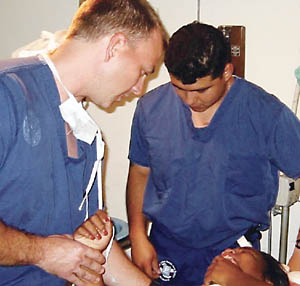 |
| Lt. Commander Brent Thiel (left) and Petty
Officer Felipe Rios in Chuuk hospital with
patient.
| |
The Ayuda Foundation (ayuda is the Spanish and
Chamorro word for help) was started on Guam in 1995 by
then-Senator Carlotta Leon Guerrero, Dr. Michael Cruz and
Continental Micronesia. They wanted the organization to
improve access to health care for Islanders.
Grasping the seriousness of the storm situation on Chuuk,
Guerrero first contacted the commander of Guam Naval Hospital.
“When you really need a whole lot of something medical, Naval
Hospital is the one,” she says.
Meanwhile Chata‘an hit Guam on Friday, July 5, three days
after the Chuuk devastation. On Saturday, Leon Guerrero and
Cruz assembled a team of five medical volunteers and gathered
donations of much-needed supplies. “We were able to put
together about 26 boxes of medical equipment and supplies as
well as a bunch of boxes of medicine from Naval Hospital.”
One day after the supplies left on July 7, Continental
Micronesia carried the team of Cruz, a surgeon; Lt. Commander
Brent Thiel, a Navy orthopedic surgeon; Petty Officer Felipe
Rios, an orthopedic technician; Commander Robert Hunter, a
family practice physician; and Jennifer Rosario, head nurse in
Guam Memorial Hospital’s surgical unit. The group reported to
the Chuuk hospital in Weno, to assist the overwhelmed
staff.
In the best of times, medical services on Chuuk are plagued
by shortages of medicine and equipment. So without proper
care, lacerations, punctures and abrasions had become infected
by the time the Navy and Ayuda personnel arrived. “When we got
there, we must have spent 10 or 12 hours just cleaning out
wound after wound,” says Rosario. Though the team arrived a
week after the storm, many wounds still contained gravel and
soil. “We had one gentleman with a grossly infected thumb that
we had to take off,” says Thiel. “Another we had to amputate
below his knee because his wounds were so infected. There was
nothing we could do to save his limb.”
The X-ray machine at the Weno hospital had not been working
even before the storm. Without a working X-ray machine, the
doctors diagnosed fractures by symptoms alone. One broken hip
was undiagnosed until the patient was medivaced to Guam a
month later. In order to put a patient into traction, Thiel
went to a hardware store and “got some pulleys and rope and
stuff like that,” according to Rosario.
One of the more tragic episodes involved a boy with an open
skull fracture, and extremely severe lacerations to his armpit
area and leg. For three days, the surgeons operated on the boy
for several hours each day. On the fourth day, the boy
died.
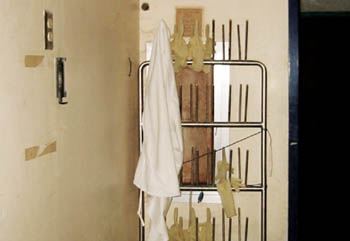 |
| Rubber gloves drying in the Chuuk hospital
so they can be
reused. | |
“To see an 11-year-old, healthy kid go through something
like that has a profound and lasting effect,” says Thiel. “And
then to realize that if he wasn’t in that setting, he probably
wouldn’t have died.”
Hunter had the additional task of making recommendations to
FEMA and the Naval Hospital. Much of his information was
gathered through contact with the Air Force Civic Action Team
(CAT) stationed in Chuuk and missionary Terry Colson. Lt.
Stephen Clark, a visiting Navy physician connected with CAT,
and Master Sergeant Dale Kirby, the CAT medical corpsman,
traveled to Tonoa island, the site of much of the
devastation.
Dr. Mark Keim of the Centers for Disease Control and
Prevention arrived in Chuuk July 15. (His comments here are
his own and do not represent the CDC.)
“Many victims with serious injuries remained untreated in
their villages,” he says. “Most with traumatic injuries now
worsened by secondary wound infections, unsplinted broken
bones, as well as lack of basic shelter, food and
sanitation.”
Though tasked with providing technical assistance only, he
and other U.S. medical personnel traveled from island to
island in the lagoon, providing medical care on their own
time. For several days he did not even have a stethoscope.
On July 21, Ayuda volunteer nurses Rose Perez of the Guam
Nursing Center and Rhonda Green with Baptists in Mission flew
to Chuuk via Continental Micronesia after having been unable
to land two days earlier on a stomach-churning C-130 flight.
Perez dressed about 16 wounds daily. She lamented the lack of
pain medicine.
After they were on the ground, she says, they found that
“some of the victims’ wounds were so deep that normally, if
you touched a wound like that, the patient would be screaming.
But during the dressing, they just closed their eyes and let
you work on them.” The local nurses were so accustomed to
shortages that when Perez suggested they change gloves after
every patient, they responded that the gloves would run
out.
“They had to take nonsterile gauze and put it in the
sterilizer so we could use it,” says Green.
Without sufficient government support, the Weno hospital
could not provide adequate service even before the storm, so
NGOs like Ayuda, military volunteers and religious
organizations have had to take up the slack. In many ways,
healthcare on Chuuk was already in crisis when the winds of
Chata‘an blew in, exposing the crisis for all to see.
Photos: Dr. Michael Cruz |